
Start with the symptom you can see
Most leaks are found because of a clue, not a flood. These are the symptoms that bring in most calls.
- The water meter keeps moving after every fixture is off.
- Your water bill jumped with no change in how you live.
- A ceiling stain that grows after someone uses the bathroom above.
- A warm patch on a floor, or hot water arriving slowly.
- The sound of running water in a quiet house.
- Low pressure that appeared without a clear reason.
If any of these match, call us and tell us which one. The answer changes which tool we bring.
Active leak emergency: what to do first
A hidden leak is a slow emergency. A visible leak behind a wall or through a ceiling is a fast one.
- Close the main water shutoff, usually near the meter or where the line enters the basement.
- Switch off power to any area where water is near outlets, ceiling fixtures or appliances.
- Move belongings out of the wet zone and open a window if the room is damp.
- Photograph the damage and the meter reading for your records.
Then call (973) 488-5410. We dispatch 24/7, and same-day appointments are available when the schedule allows.
Meter still running or a high water bill
A simple test starts it. Turn off every fixture and appliance, then watch the small dial or leak indicator on the meter. If it moves, water is leaving the system somewhere.
Try closing the main valve at the house. If the meter keeps moving with the valve closed, the leak is on the line between the meter and the house. If it stops, the leak is inside the building. This one test saves hours.
Belleville's meters and billing run through the Belleville Water Department at 973-450-3414, and the department can tell you about your reading history.
How we find the leak without opening everything up
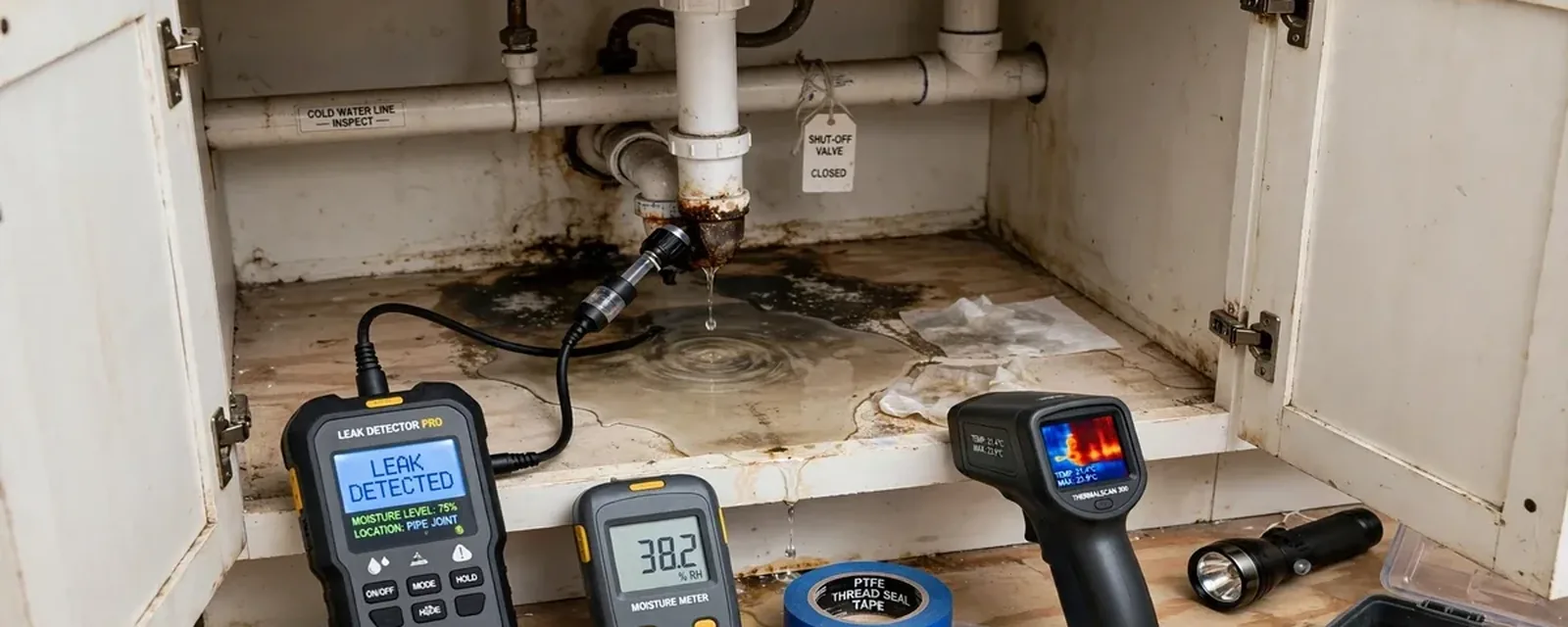
No single tool finds every leak. We combine them.
| Tool | What it finds | Best for |
|---|---|---|
| Acoustic listening gear | The hiss of water escaping under pressure | Pressurized lines in walls, floors and the yard. |
| Thermal imaging | Temperature differences from hot or wet areas | Hot water leaks, radiant pipes, wet insulation. |
| Pressure testing | Pressure loss in an isolated line | Confirming which branch is leaking. |
| Moisture meter | Dampness inside drywall and framing | Ceiling, wall and under-sink leaks. |
| Tracer gas | Gas escaping from a pipe | Hard-to-hear leaks in sealed lines. |
Once we confirm the spot, we show you the reading and quote the repair before any wall is opened.
Ceilings, walls and attics
A ceiling stain is often not under the leak. Water travels along joists before it drops, so the stain may be several feet from the source.
We trace from the stain outward with a moisture meter and thermal camera. A bathroom supply line, a shower pan, a roof penetration or a heating pipe can all look the same from below, and the repair for each is very different.
Basements, crawlspaces and under-house leaks
Belleville homes mostly sit over basements, and a leak there can hide behind finished walls or under flooring. A damp basement wall can be a plumbing leak, a seepage problem or a drain issue, and the three need different answers.
We check the supply lines, the drain stacks and the boiler or water heater connections first. If the evidence points to groundwater instead, we tell you honestly and point you toward basement waterproofing or sump pump work instead of billing for a plumbing repair that will not fix it.
Slab leaks, buried lines and irrigation
Slab leaks are less common in basement homes, but they occur in additions, garages and some apartments built on concrete. A warm spot, hot-water loss, or the sound of water under the floor points that way.
Buried line leaks run between the street and the house. Flow dropping at the meter, a wet patch in a yard or sidewalk, and a bill that climbs for no reason point there. See water service line repair for the repair side.
Irrigation lines, yard faucets and pool or spa plumbing leak too. We check them when the meter test points outdoors.
Meter box and curb stop leaks
The curb stop and meter box sit in a public space, and a leak there can belong to the utility or to the owner depending on where it is. We trace the leak, confirm which side of the shutoff it is on, and tell you who should fix it.
What the repair must follow
Finding a leak is diagnostic. Fixing it is plumbing work. New Jersey's plumbing subcode adopts the National Standard Plumbing Code Illustrated, 2021 edition, through N.J.A.C. 5:23-3.15. A repaired supply line or drain has to meet it, and work in New Jersey must be done by a master plumber or an authorized plumbing contractor or their employees.
What leak detection costs and what changes it
We quote before work starts. The price depends on how much searching the leak needs.
- The symptom and locationA visible ceiling stain is quicker to trace than a buried line under a driveway.
- Number of fixtures and floorsMore plumbing to test means more time.
- Access to the main valveA working shutoff speeds the pressure test.
- Repair afterwardDetection finds the leak. The repair is quoted separately, and you decide on it.
- Emergency dispatchAfter-hours calls cost more than weekday appointments, and we tell you first.
Insurance note: sudden and accidental water damage is often covered. Long-term seepage and the cost of finding the leak itself may not be. Ask your insurer what applies before repairs begin.
Want a real number? Call (973) 488-5410 and describe the symptom.
Questions Belleville homeowners ask about leak detection
Yes. Our line is open 24/7. If water is actively leaking, we walk you through the shutoff and dispatch as quickly as we can.
Turn off all water, then watch the leak indicator or low-flow dial. If it moves, water is escaping. Closing the house main tells you whether the leak is inside or outside.
Usually only one small opening, after we have located the leak. We confirm the spot with instruments first so the repair is as small as possible.
Often yes, with acoustic gear and thermal imaging, though it depends on pipe depth and noise around the house. We tell you honestly what we can and cannot confirm.
Yes. Send the building address and the tenant contact. We document the findings with photos for your records.