How a tankless heater differs from a tank
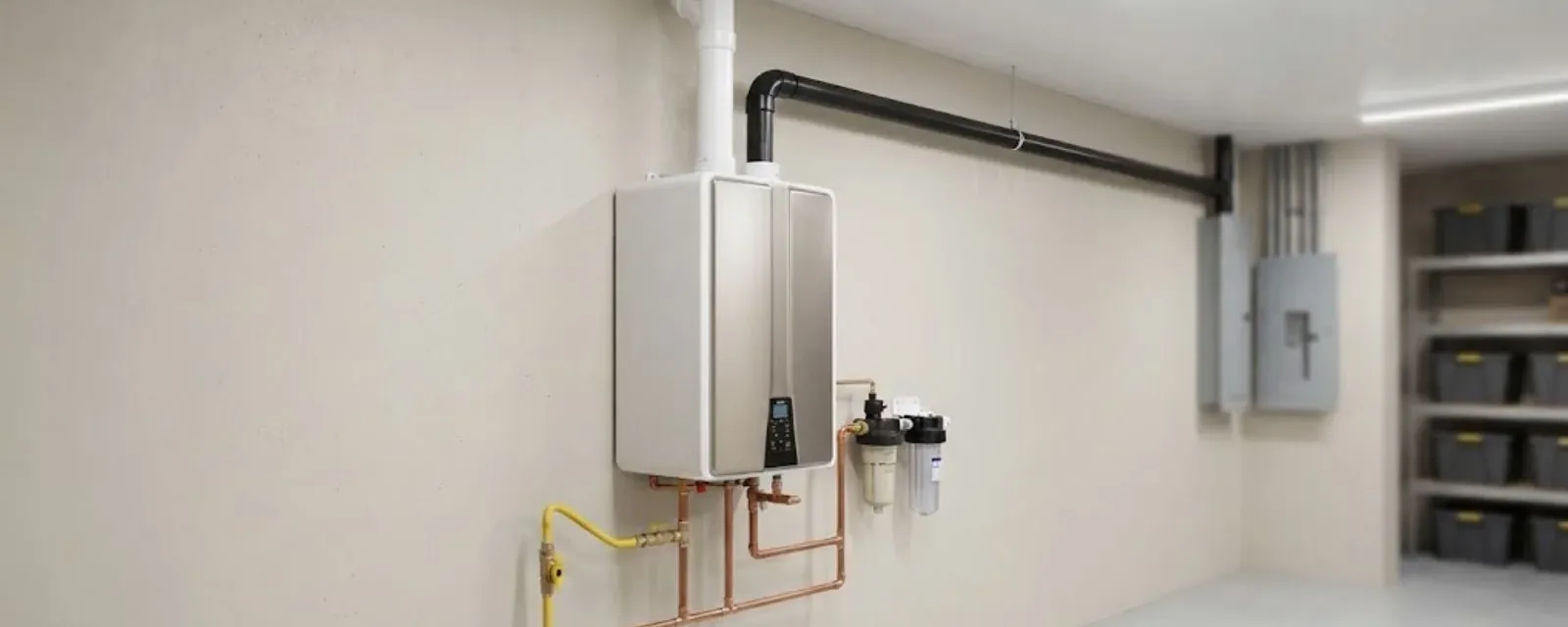
Water enters the unit when you open a tap. A burner or element heats it as it flows through the heat exchanger, and the unit shuts off when the tap closes.
That means no standing tank to lose heat, and hot water that lasts as long as the flow does. It also means the unit works hardest in winter, when incoming water is coldest, and that the gas line has to supply a large burst of fuel at once.
Tank or tankless: where each one fits
A tankless unit is not right for every house. This table shows where it wins and loses.
| Factor | Standard tank | Tankless |
|---|---|---|
| Hot water supply | Limited to the tank, then recovery | Continuous, limited only by flow rate. |
| Footprint | Large floor space | Wall mounted, small. |
| Install complexity | Simple swap | Gas line, venting and sometimes electrical changes. |
| Maintenance | Annual flush, anode rod | Annual descale flush, filter cleaning. |
| Typical failure | Tank leaks | Error codes, scale, ignition and flow sensors. |
If you are replacing a failed tank, compare it with a standard water heater installation before choosing.
Install details that decide the quote
Gas tankless units need a gas line sized for their BTU rating. An old half-inch line serving a range and furnace may not carry enough, and the fix is a larger run from the meter.
Venting is the other big variable. Tankless units use sealed venting made for the unit, and the route to the outdoors sets the labor. We measure both before quoting, so the number you hear is the number you pay for that scope.
Flushing and descaling: the service most owners skip
A heat exchanger collects mineral scale over time. Scale narrows passages, raises the temperature at which the unit trips on high limit, and leads to error codes or lukewarm water.
A flush uses a pump, hoses and a descaling solution to circulate through the exchanger. Most manufacturers call for an annual flush, and the interval is written in the manual for your model.
Belleville's water is soft. The 2023 report listed hardness at 48.7 ppm, about 2.9 grains per gallon, so scale builds slower here than in harder towns. Slower is not zero, and the flush is still the cheapest way to extend the life of the unit.
Signs a tankless unit needs service
Do not wait for a full shutdown. These early signs usually mean scale or a sensor fault.
- An error code on the display that returns after a reset.
- Hot water that cycles between hot and lukewarm.
- Longer wait for hot water than the unit used to need.
- Popping or kettle-like noises from the unit.
- A drop in flow at the shower that the filter screen does not fix.
Write down the code and the model number. We can often tell you what failed before the visit.
Repair or replace
A tankless unit that is a few years old with an error code is nearly always worth repairing. The heat exchanger is the most expensive part, and a flush may be all it needs.
A unit that has been neglected for many years, with a cracked exchanger or repeated ignition failures, is a replacement conversation. We give you both prices when the answer is close.
For failures of any kind that leave you with no hot water tonight, see water heater repair.
Standards that govern the install
New Jersey's plumbing subcode adopts the National Standard Plumbing Code Illustrated, 2021 edition, through N.J.A.C. 5:23-3.15. The plumbing side includes the relief valve, isolation valves and condensate drain. Gas and venting follow the manufacturer's instructions and the fuel gas rules, and any new circuit falls under the National Electrical Code (NEC).
What changes the price of tankless work
We quote before work starts. These are the real cost drivers.
- Install or serviceA flush is a short job. A new install includes gas, vent and water work.
- Gas line sizeA longer or larger run to the unit adds material and labor.
- Venting routeA short vent through a nearby wall costs less than a long one through a finished space.
- Model and capacityHigher flow rates cost more, and cold-weather performance depends on the unit chosen.
- Isolation valvesA service valve kit makes every future flush faster, and we recommend it on any install.
Insurance note: tankless work is a planned upgrade and not an insurance claim. A sudden leak from a failed unit may be treated like any other water damage claim, so photograph the damage first.
Want your real number? Call (973) 488-5410 with the model number.
Questions Belleville homeowners ask about tankless water heater
Yes. Our 24/7 line takes tankless calls too. A unit that has failed completely gets the fastest appointment available, and a flush can be booked for a day that suits you.
Follow the interval in the manual for your model. Many manufacturers call for a flush about once a year, and the schedule matters more where water is harder than in Belleville.
Codes usually point at ignition, flame, flow, venting or temperature faults. Write down the code and call. We can often narrow the cause on the phone.
Sometimes. We check pipe size and length against the unit's BTU rating before we quote, because an undersized line starves the burner.
Yes, with a clear plan for which unit serves which apartment. We check venting, gas supply and shutoffs before recommending it.
Belleville, Nutley, Bloomfield, Newark, Kearny and North Arlington.