When a camera inspection is worth it
These are the common reasons people call.
- You are buying a house and want to know the condition of the line before closing.
- A drain clogs repeatedly and cabling only helps for a short time.
- You have an older home with clay, cast iron or fiber pipe.
- Large trees stand near the line.
- You want proof of the condition before a repair or lining job.
- A previous repair needs to be checked.
Our hydro jetting service often starts with exactly this camera pass.
What the camera sees
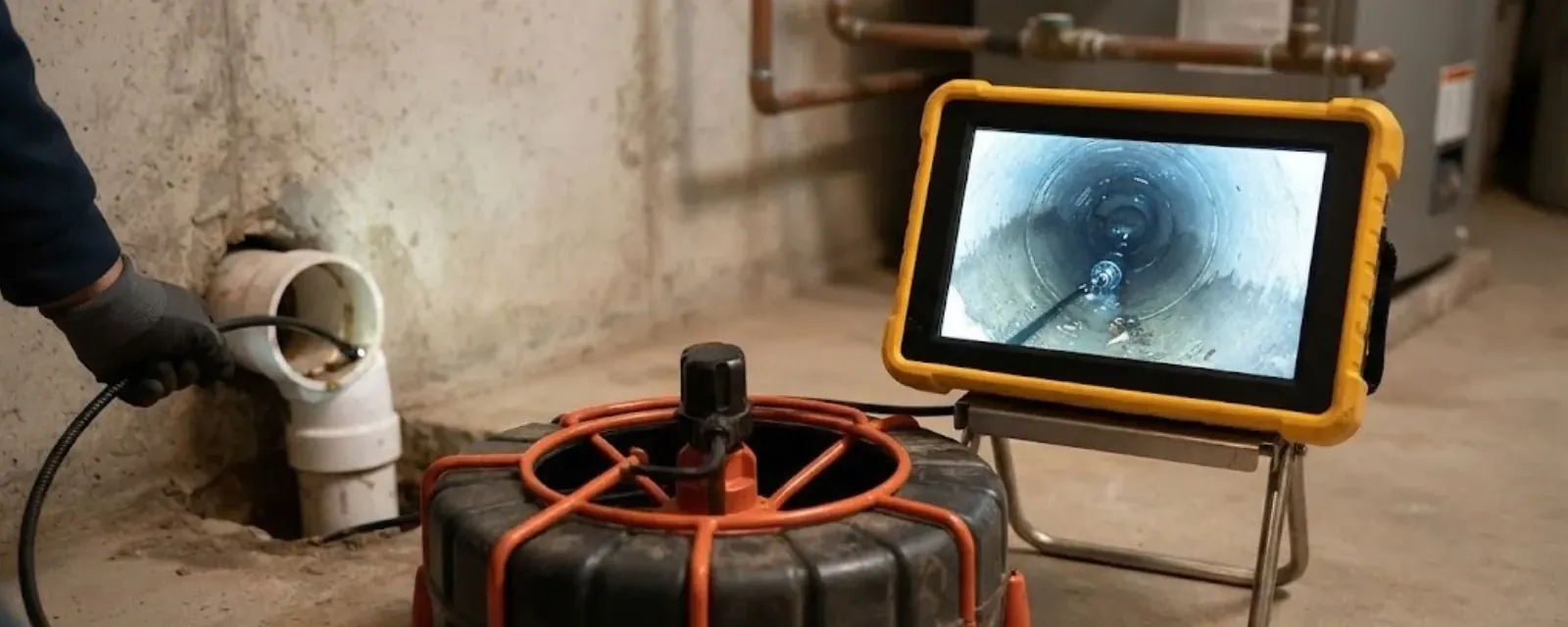
The camera head has lights and a sealed lens on a flexible cable. The operator advances it slowly, watches the live feed, and records the video. A locator on the camera head lets the crew find its position above ground, which gives you depth and distance for any defect.
We mark the location of each problem on a simple sketch, so a later repair crew can find it again.
What we look for and why it matters
Each finding points to a different next step.
| Finding | What it means | Typical next step |
|---|---|---|
| Root intrusion | Roots entering at joints or cracks | Cut and jet, then consider lining. |
| Bellied pipe or sag | A low spot that holds water and waste | Monitor, or replace the section. |
| Offset or separated joint | Pipe sections no longer align | Spot repair or lining depending on gap. |
| Cracks or breaks | Pipe wall damage | Lining or section repair. |
| Scale and grease | Buildup narrowing the pipe | Jetting and maintenance. |
| Collapse | Pipe has failed | Replacement. |
For repair choices see sewer line repair.
Pre-purchase inspections
A home inspection rarely covers the buried sewer line. A camera does. If you are buying an older house, ask whether a cleanout exists, and schedule the camera before your contract deadline so you have time to negotiate.
You get the video and a plain-language summary of what we saw. We do not tell you to walk away from a house. We tell you what the pipe looks like and what a repair would involve.
The Belleville and Essex County context
Belleville sits between the Second River and the Passaic River, with older housing stock throughout. Many lines here have been in the ground for generations.
Ask the Belleville township office at 973-450-3300 about local requirements. Some municipalities require sewer lateral inspection at property sale, and the township can say what applies to your address.
How the visit works
A typical inspection takes about an hour.
- Locate the access pointWe find the cleanout or pull a toilet if no cleanout exists.
- Run the cameraWe advance the camera to the main and record the whole run.
- Review with youWe show you the footage, point out each defect and mark depths.
- Written summaryYou receive the video and a list of findings, with repair options if any are needed.
Standards for the findings
A camera report is only useful if it is read against a standard. Pipe slope, joint alignment and cleanout access are set out in the plumbing subcode, New Jersey's subcode adopts the National Standard Plumbing Code Illustrated, 2021 edition, through N.J.A.C. 5:23-3.15. We compare what the camera shows with those requirements when we explain a defect.
What changes the price of an inspection
Inspections are priced by the visit, and we tell you the price before we start.
- AccessA working cleanout is faster than pulling a toilet.
- Line lengthA long run to the street takes more time.
- Cleaning needed firstA line packed with grease or roots may need cleaning before the camera can pass.
- Locating and mappingSurface marking adds time but helps any later repair.
- TimingSame-day or after-hours visits cost more than a planned weekday one.
Insurance note: inspections are usually not covered by homeowners policies. If a claim is possible, ask your insurer whether they want to see the video.
Want to book? Call (973) 488-5410 and tell us the address and the reason.
Questions Belleville homeowners ask about sewer camera inspection
Often yes. Our line is open 24/7, and we offer same-day appointments when the schedule allows.
Yes. You get the recording and a plain summary of the findings.
A cleanout makes it easy. Without one, we can often run the camera through a toilet or roof vent, though that takes more time.
Yes. A locator on the camera head lets us find its position and depth from above ground.
Newer homes have fewer problems, but a camera still catches construction debris and offset joints. It matters most for older housing and shared laterals.
Yes. See Nutley and Bloomfield. We cover both from Belleville.