
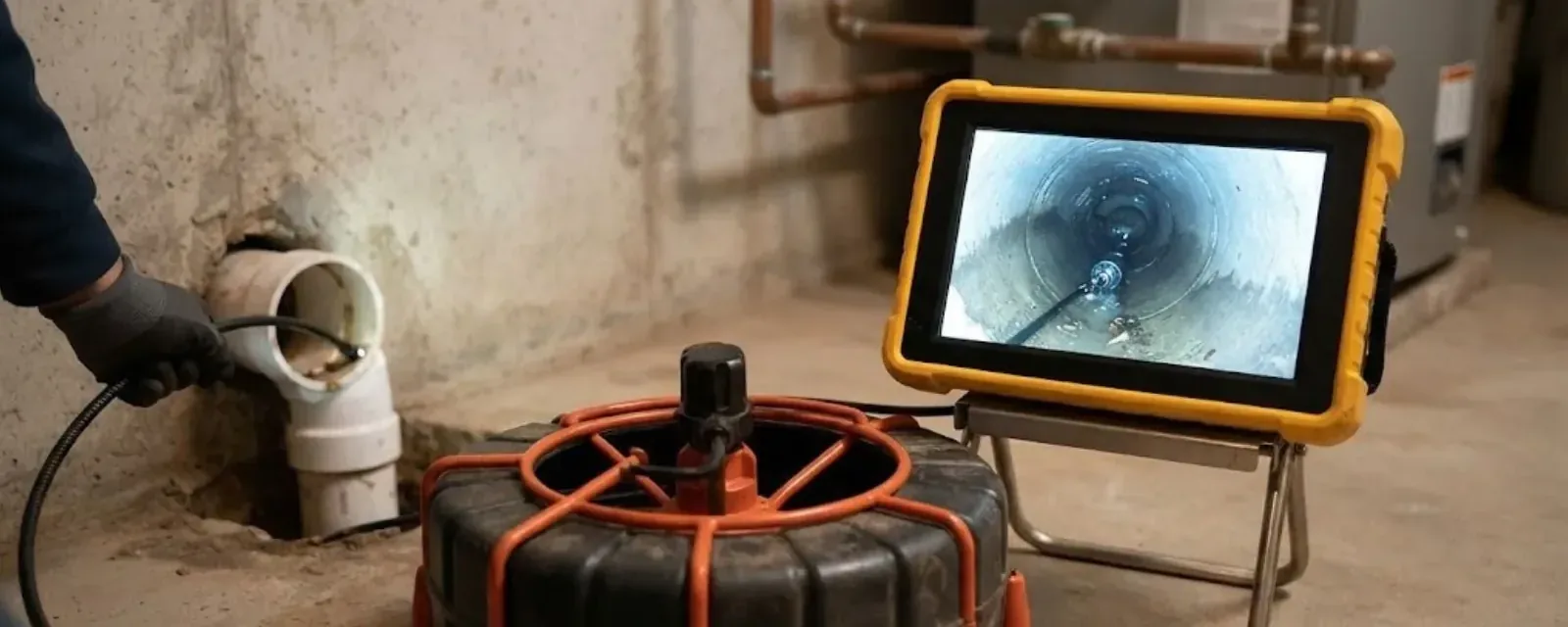
What a lateral is
A sewer lateral is the pipe between your house and the public sewer in the street. Everything you flush or wash down a drain travels through it. The lateral usually belongs to the property owner, up to the point where it joins the main, though the exact boundary depends on the municipality.
Because it is buried, most owners never see it. A failing lateral can go unnoticed for years, then back up all at once.
When owners and buyers order an inspection
These are the usual triggers.
- Buying a house, especially an older one.
- Recurring clogs that cabling clears only briefly.
- Gurgling drains or sewer odors.
- Large trees near the line.
- Planning a lining or repair and needing the exact location of defects.
- Checking work after a previous repair.
For buyers, the inspection should happen before the contract deadline.
What should be in the price
Compare quotes by what they include.
| Item | Should be included | Ask about |
|---|---|---|
| Camera run | Full length from cleanout to the main | Does it reach the street connection? |
| Video recording | A copy you keep | Is it delivered digitally? |
| Locating | Depth and position of defects | Is surface marking included? |
| Written findings | Plain summary of the condition | Will it list recommended actions? |
| Cleaning | Light clearing so the camera passes | What if heavy cleaning is needed? |
Our sewer inspection page covers what the camera sees.
What changes the price
Access is the biggest factor. A working cleanout near the house lets the camera go in without moving anything. Without one, the crew may have to pull a toilet or use a roof vent, which takes more time.
Line length and condition matter next. A long run takes longer, and a line packed with roots or grease may need cleaning first. If the camera cannot pass a blockage, the inspection may need to be repeated after the line is cleared.
Timing also matters. A planned weekday inspection costs less than a same-day or after-hours call.
Reading the findings
A good inspection report separates minor issues from serious ones. Light root hairs at a joint are different from a collapsed section. A small belly that holds a little water is different from a pipe that is full.
Ask the plumber to show you the footage and mark each defect on the sketch. If a repair is recommended, ask for the options. Lining, spot repair and replacement all have different costs and different lifespans.
How the visit works
A typical inspection takes about an hour.
- Find the accessThe crew locates the cleanout or alternate entry.
- Run the cameraThe camera travels the line while the live feed is recorded.
- Mark defectsDepth and distance for each problem are noted.
- ReviewYou see the footage and get a summary.
Do not pay for work you do not need
An inspection should lead to a clear next step, not an automatic repair. If the line is in good condition, you should hear that. If it needs maintenance, you should be told how often.
If a contractor proposes a major repair, ask to see the footage that supports it. You can always get a second opinion with the recording.
Lining, spot repair and replacement compared
If the camera finds trouble, three paths are common. Lining restores a cracked pipe from the inside with a resin liner, and it suits pipes that still hold their shape. Spot repair replaces one failed section by digging to it. Full replacement removes the old pipe and installs new.
The footage tells you which is realistic. A pipe with one broken joint wants a spot repair. A pipe with cracks along its length suits lining. A collapsed or heavily offset pipe wants replacement.
How to use the report in a purchase
Send the video to your attorney or agent before the due diligence period ends. A defect can be a reason to ask for a repair credit or a price change. A clean report gives you confidence in a house you plan to keep for years.
Keep the recording with your house records. It is a baseline for any future inspection.
Pipe materials you may see on the screen
Clay pipe shows joints every few feet, and roots often enter there. Cast iron looks rough and scaled inside. Orangeburg fiber pipe looks gray and may be oval or flattened. PVC looks smooth and white or green. Each material ages in its own way, and a plumber can explain what yours is telling you.
Frequency: how often to inspect
A line in good condition may need a camera only every several years. A line with roots, grease or an older material may benefit from a yearly look. Ask your plumber to set a schedule based on what the camera shows.
Standards the footage is compared with
New Jersey's plumbing subcode adopts the National Standard Plumbing Code Illustrated, 2021 edition, through N.J.A.C. 5:23-3.15. It sets slope and joint rules for drains. The camera shows how far the real pipe is from them, and call 811 before any follow-up dig.
Quick reference: what moves the price
We quote before work starts.
- Access to the lineA cleanout makes the visit faster.
- Length and obstructionsLong or blocked lines take more time.
- Cleaning before the cameraHeavy roots or grease may require a separate cleaning.
- Locating and markingSurface marking adds time but helps repairs.
- SchedulingSame-day and after-hours visits cost more.
Insurance note: inspections are usually not covered. If a claim is possible, ask your insurer whether they want to see the recording.
Want to book? Call (973) 488-5410.