What an expansion tank does
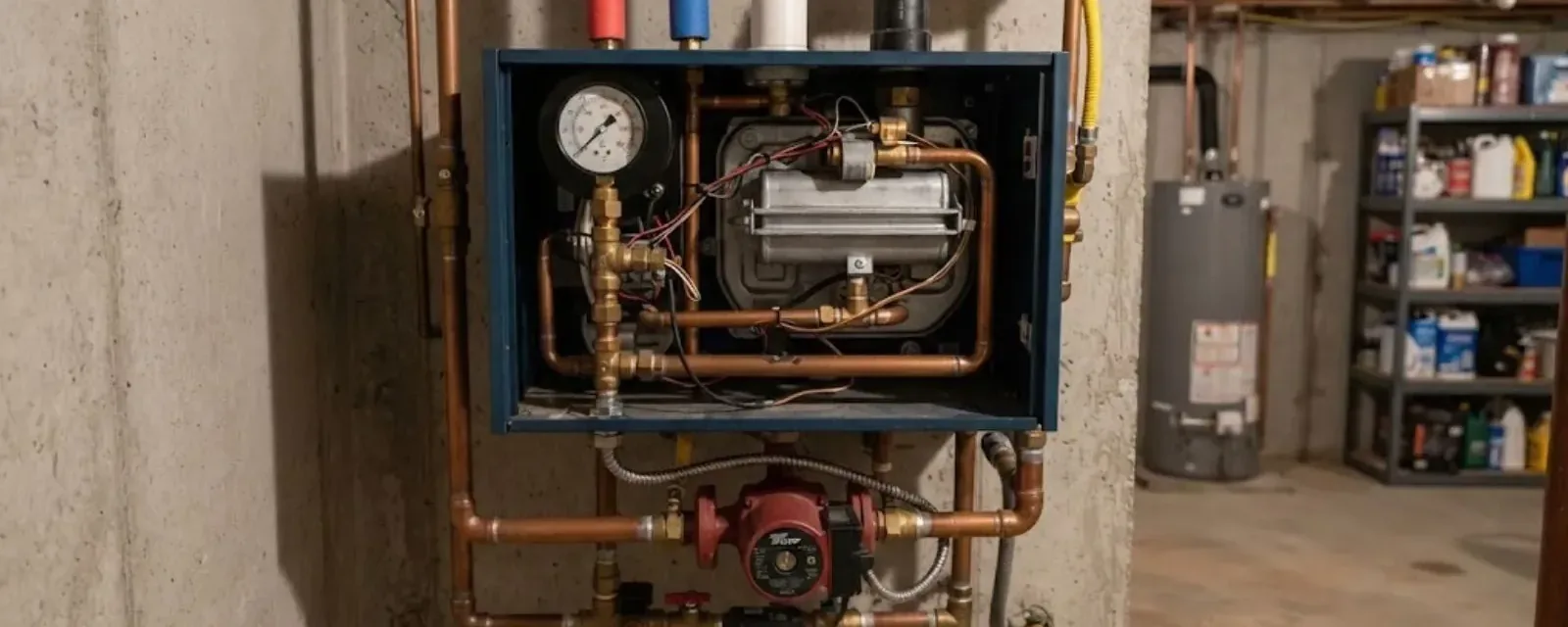
Water expands when it heats. In a closed heating loop, that expansion has nowhere to go, so pressure climbs. An expansion tank gives the extra water a place to go. Inside the tank, a rubber diaphragm or bladder separates the water from a cushion of air.
As water heats and expands, it pushes into the tank and compresses the air. When the water cools, the air pushes it back. The whole system keeps a steady pressure without opening the relief valve.
Two common types
Older systems often have a plain steel tank, called a compression tank, hung from the ceiling joists. It has no bladder, so the air can slowly dissolve into the water. When that happens, the tank becomes waterlogged and needs to be drained and recharged.
Newer systems use a diaphragm or bladder tank, usually a small steel cylinder mounted near the boiler. A failure here usually means the diaphragm has torn or the air charge has leaked, and the tank is replaced.
Signs the tank has failed
Several symptoms point to the tank, but none alone proves it.
| Symptom | What it suggests | Next step |
|---|---|---|
| Pressure climbs when the boiler heats | Little or no air cushion | Check the tank and its air charge. |
| Relief valve drips or discharges | Pressure is hitting the limit | Test the tank, then inspect the valve. |
| Tank feels full of water all over | Waterlogged or torn diaphragm | Replace the tank. |
| Water drips from the tank | Rusted shell or failed seam | Replace the tank. |
| Boiler cycles on and off quickly | System has no room to expand | Check the tank and zones. |
Our boiler repair page covers other causes of pressure problems.
A simple test you can try
Do this only with the boiler off and cool. If you are not comfortable, call a plumber.
- Shut off the boilerTurn off power and let the system cool.
- Tap the tankKnock on the top and bottom. A healthy tank sounds hollow on top and solid on the bottom.
- Check the air valvePress the small valve on the tank. If water sprays out, the diaphragm has failed.
- Read the gaugeNote the pressure cold, then again when the boiler is hot.
If the tank is full of water at the top, replacement is the usual answer.
Why not just recharge it
On a bladder tank, adding air can help only if the diaphragm is intact. If water comes out of the air valve, the diaphragm is torn, and no amount of air will fix it.
Replacing a tank that is close to the end of its life costs less than paying for repeat visits. The tank is also cheap compared with the damage a dripping relief valve can do to a floor, a ceiling or a boiler.
What a replacement visit includes
A proper replacement is more than swapping a tank.
- Shutting off power and isolating the boiler.
- Draining enough water to remove the old tank.
- Installing a correctly sized tank on the right fitting.
- Setting the air charge to match the system fill pressure.
- Refilling, purging air and checking for leaks.
- Testing pressure when the boiler is hot.
We check the relief valve and the fill valve at the same visit, since a failed tank often stresses both.
Sizing and placement matter
A tank that is too small cannot absorb the expansion of a large system, and the symptoms return within a season. Size depends on the water volume, the temperature and the pressure.
Placement matters too. The tank belongs on the supply side with an air purge, and a tank hanging in the wrong spot can trap air or sludge. We confirm the layout before we install.
Safety
A relief valve that discharges is a warning. If it opens often, there is a pressure problem that needs attention. Never plug or cap a relief valve, because it is the last line of protection.
If you smell gas near the boiler, leave the building and call PSE&G at 1-800-880-7734, then 911 if the smell is strong. Install carbon monoxide alarms near the boiler and on each floor.
Before you call a plumber
Note the pressure on the gauge when the boiler is cold and again when it runs. Look for water at the relief valve discharge pipe and under the tank. Take a photo of the tank label and any nameplate. This takes five minutes and shortens the phone call.
Standards for boiler plumbing
New Jersey's plumbing subcode adopts the National Standard Plumbing Code Illustrated, 2021 edition, through N.J.A.C. 5:23-3.15. It covers relief valve discharge and expansion tank connections. Never cap or plug a relief valve.
Quick reference: what changes the price
A tank swap is usually one of the smaller boiler repairs. These factors move the number.
- Tank type and sizeA larger or more complex tank costs more.
- AccessA tank hung from a ceiling takes more work to reach.
- Extra partsA worn valve or fitting found during the job adds parts.
- System sizeLarger systems take longer to refill and purge.
- TimingA winter night call costs more than a weekday visit.
Insurance note: a sudden leak that damages property may be covered, while wear and tear on the boiler or tank is not. Photograph any water damage before cleanup.
Pressure problems? Call (973) 488-5410.